
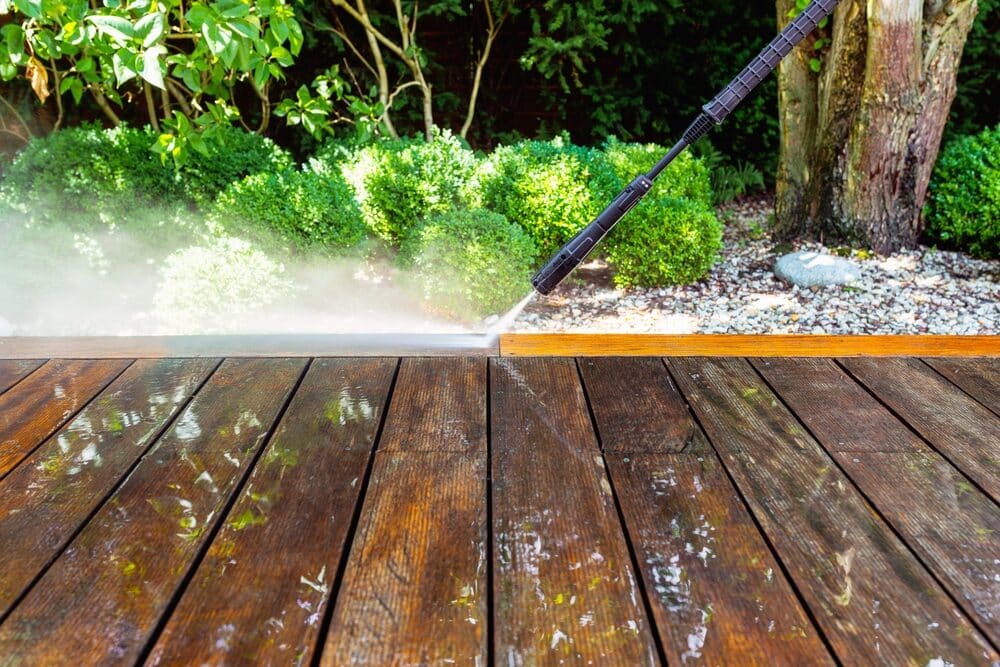
A 3,200 PSI fan tip held four inches from a cedar deck board will carve visible grooves in under two seconds, and that damage never sands out completely. Most gray, fuzzy, splintered decks are not ruined by weather alone; they are ruined by one aggressive afternoon of power washing with a rented machine. At D&K Power Washing, our fix for weathered wood relies on low pressure, the right nozzle, and specialized cleaners that do the actual work without damaging the wood fibers.
What High Pressure Actually Does to Deck Boards
Wood is not a uniform material. Each growth ring contains soft earlywood (the light bands) and dense latewood (the dark bands), and water at 3,000 PSI erodes the soft bands several times faster than the hard ones. That is why an over-washed board feels corrugated under bare feet a week later.
The second problem is fiber tearing. Pressure lifts and breaks the surface fibers rather than cutting them cleanly, leaving a raised, furry layer that the USDA Forest Products Laboratory describes in its research on wood weathering and surface degradation. Those torn fibers hold water, so the board stays damp longer and grays faster than it did before.
Third, stain and sealer will not bond to damaged fiber. Once the surface is fuzzed, finish soaks unevenly into the gouges and sits on top of the dense ridges, which is how decks end up blotchy eight weeks after a fresh coat.
The Numbers That Matter: PSI, Nozzle and Distance
Deck restoration is a narrow window, not a range of personal preference. These are the figures professionals work inside when cleaning softwood decking:
- Pressure: 500 to 800 PSI for cedar, redwood and old pine; up to 1,200 PSI for sound pressure-treated southern yellow pine.
- Nozzle: a 25-degree (green) or 40-degree (white) tip, or better yet a rotating surface cleaner attachment that spreads the load.
- Distance: 10 to 14 inches from the board, never closer than 6 inches.
- Motion: continuous passes with the grain, overlapping each stroke by about one third, with no pausing at the end of a board.
- Flow: 3 to 4 GPM matters more than PSI, because volume rinses debris away instead of blasting it into the grain.
Zero-degree red tips have no place on a deck, a railing, or honestly on most residential surfaces. The Consumer Product Safety Commission has documented serious pressure washer injection injuries from exactly that nozzle, and the wood damage is the smaller of the two risks.
Chemistry Does the Work, Pressure Only Rinses
Gray wood is not dirt. It is a thin layer of ultraviolet-degraded lignin, usually 0.005 to 0.02 inches deep, mixed with mildew and tannin bleed. You can blast that layer off with brute force, or you can dissolve it and rinse it away, and only one of those leaves the board intact.
Sodium percarbonate deck cleaners, mixed at roughly 4 to 8 ounces per gallon of warm water, brighten gray wood in 10 to 15 minutes of dwell time without scouring. A follow-up oxalic acid brightener at around 4 ounces per gallon neutralizes the surface, pulls out iron stains around fasteners, and brings back the warm tone that makes a 15-year-old deck look five.
Chlorine bleach is the shortcut people reach for, and it is the wrong one on wood: it degrades lignin further, corrodes fasteners, and kills surrounding plantings.
A Deck Restoration Sequence That Protects the Lumber
- Inspect first. Probe joists and ledger boards with a screwdriver; if it sinks more than a quarter inch, you have rot, not a cleaning problem.
- Clear and protect. Move furniture, pre-wet shrubs, and cover any low-voltage lighting.
- Apply cleaner. Work in 100 to 150 square foot sections so nothing dries on the wood.
- Dwell 10 to 15 minutes. Mist lightly if the surface starts drying, especially above 80 degrees.
- Agitate. A stiff deck brush on stubborn mildew beats adding 1,000 PSI every time.
- Rinse at low pressure. Even passes with the grain, 25 or 40 degree tip.
- Brighten and neutralize. Oxalic acid, rinse thoroughly.
- Dry 48 to 72 hours. Target under 15 percent moisture content before any stain goes down.
That drying window is where most weekend projects fail. Sealing damp wood traps moisture and causes peeling within a season.
Composite Decks Follow Different Rules
Capped composite boards from Trex, TimberTech and Fiberon scratch under high pressure just as readily as wood, but they do not fuzz; they haze and streak permanently. Manufacturers typically cap their warranty-safe cleaning at 1,500 PSI with a fan tip, and some void coverage for any pressure washing at all.
What Professional Deck Cleaning Costs
Most homeowners pay between $0.75 and $2.00 per square foot for a cleaned and brightened wood deck, which puts a typical 400-square-foot deck in the $300 to $700 range. Adding stain or sealer usually brings the total to $2.50 to $5.00 per square foot, depending on product selection and railing complexity.
Compare that against replacement lumber, which runs $30 to $60 per square foot installed for pressure-treated framing and decking. Cleaning the deck correctly two or three times over its lifespan is the cheaper path by a wide margin—as long as nobody takes a high-pressure turbo nozzle to the wood in between.
Commercial pressure washing is structured differently, typically ranging from $0.10 to $0.30 per square foot on flatwork, with volume discounts available for recurring service contracts. Restaurant patios, apartment decks, HOA boardwalks, and rooftop terraces all benefit from the same specialized low-pressure wood restoration process. Commercial jobs are frequently scheduled after hours or before opening so foot traffic is never interrupted, and most property managers prefer quarterly or semiannual visits over waiting for wood rot or deep graying to set in.
If you are looking for reliable pressure washing services in Doylestown, PA we utilize this exact low-pressure process to safely clean, brighten, and protect your outdoor living spaces.
Get a Free Estimate for Your Deck
D&K Power Washing cleans weathered decks, siding and concrete using pressure matched to the surface instead of a one-setting machine. Contact us today to request a free quote and we will walk the deck with you, test an area, and tell you honestly whether it needs cleaning, brightening or a carpenter.