
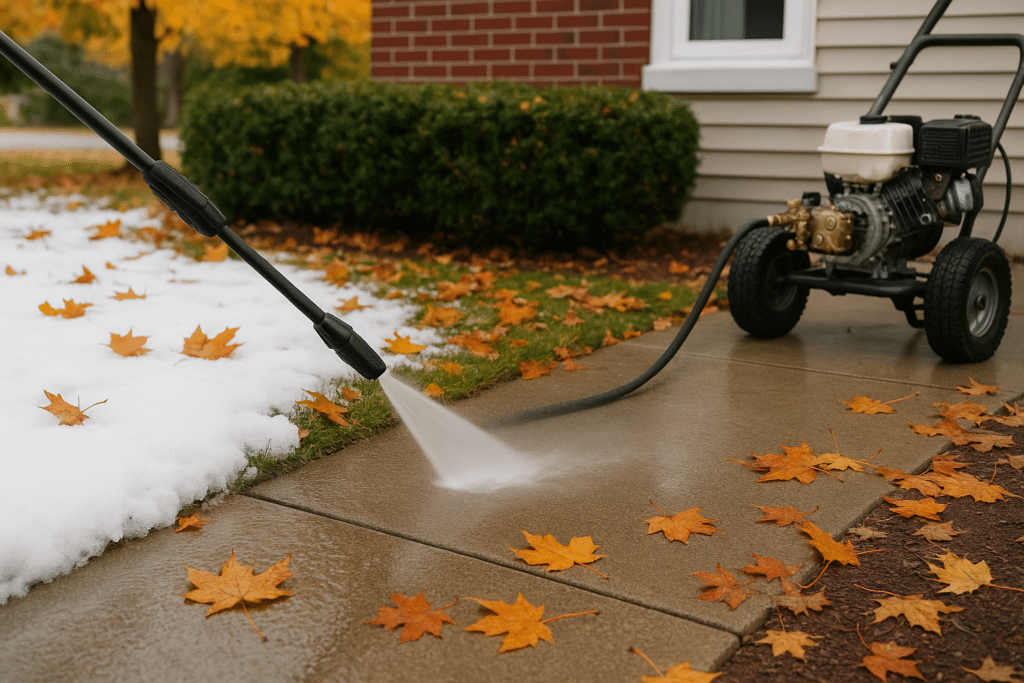
If you only schedule power washing once a year with D&K Power Washing, autumn is usually the smartest slot on the calendar. Falling leaves leave behind tannin stains and damp organic mats that feed mold all winter, and any grime still sitting on your siding or concrete in December gets locked in place by freeze-thaw cycles. Cleaning in September, October or early November clears that debris before the cold sets in, which is why so many homeowners book late-season appointments.
Spring gets all the attention because people associate cleaning with spring cleaning. The physics of the problem, though, point the other direction: what you remove in fall determines how much damage accumulates over the next five months.
The Leaf Problem Nobody Talks About Until It Stains
Wet leaves are not neutral. Oak, maple and sycamore leaves release tannins, the same acidic compounds that stain a coffee mug, and those tannins bleed into porous surfaces within a few days of sitting wet. On concrete, a pile of leaves left for two weeks can leave a brown outline that no amount of rinsing will lift.
The longer that shadow stays, the deeper it migrates into the surface. Concrete, brick pavers and unsealed wood all have open pores, so tannin staining stops being a surface issue and becomes an embedded one, sometimes requiring a dedicated cleaner rather than water pressure alone.
- Concrete walkways and driveways: tannin shadows plus the black algae that thrives under damp debris.
- Composite and wood decks: leaves trapped between boards hold moisture against the surface for weeks.
- Brick and stone patios: organic matter settles into joints and sprouts moss by February.
- Siding and soffits: wind-driven leaf litter collects behind downspouts and in corners where nothing dries out.
Clearing that debris and washing the surface underneath in fall means spring arrives without a set of stains that have had all winter to cure.
What Winter Actually Does to Dirty Surfaces
The region typically runs through dozens of freeze-thaw cycles between December and March, depending on the winter. Water works its way into hairline cracks in concrete and mortar, freezes, expands roughly 9 percent, and widens the crack slightly every time. Organic growth makes this worse, because moss and algae hold moisture in place instead of letting it evaporate.
Add road salt and ice melt tracked onto walkways, and you have a chemical load sitting on porous surfaces for months. Chloride-based deicers accelerate surface scaling on concrete, especially on slabs that were already dirty and slightly degraded going into the season.
Mold and mildew do not die off in the cold either. Spores go dormant, survive under snow cover, and restart growth the moment temperatures climb above roughly 40 degrees. The EPA notes that mold only needs moisture and an organic food source to take hold, and a leaf-packed deck corner provides both.
Fall Weather Is Genuinely Better for Washing
There is a practical reason technicians prefer autumn work. Most cleaning solutions, including the sodium hypochlorite mixes used for house washing, perform best between about 50 and 80 degrees Fahrenheit. Above 85, solutions evaporate off vertical surfaces before they have time to work, which is why August washes sometimes need a second application.
- Moderate temperatures keep detergents wet on the surface for the full dwell time, usually 5 to 10 minutes.
- Lower humidity and steady breezes help decks and wood dry in 24 to 48 hours instead of several days.
- Less direct sun reduces streaking on dark siding and painted trim.
- Dormant plants mean less risk to annuals and new landscaping around the foundation.
- Shorter wait times than the May and June rush, when most companies are booked out two or three weeks.
The one real constraint is frost. Once overnight lows sit consistently below freezing, water in lines and on walkways becomes a safety problem, which is why local crews generally close out the washing season somewhere between mid-November and early December.
The Fall Checklist Worth Working Through
Not every surface needs the same treatment, and pressure washing in Fort Washington is not always the answer. High-pressure washing suits concrete and masonry, while siding, stucco and roofs need soft washing, a low-pressure chemical application that kills growth without forcing water behind materials.
- House siding: remove the summer’s pollen, spider webs and the green film on north-facing walls before it embeds over winter.
- Roof and gutters: clear leaves so meltwater has somewhere to go instead of backing up under shingles as an ice dam.
- Driveway and walkways: wash out organic staining and tire residue so salt has a cleaner, sounder surface to sit on.
- Deck and patio: clean, dry and, if the boards need it, seal before the first hard freeze.
- Fences and retaining walls: knock back moss on the shaded side, which is where rot usually starts.
If you are staining or sealing a deck this season, build in the drying window. Most sealers need wood at 12 to 15 percent moisture content, which typically means waiting two to three dry days after washing, and that is much easier to schedule in October than in April.
Common Fall Power Washing Mistakes
Homeowners with a rented machine tend to run into the same handful of problems, and most of them are irreversible. Pressure that is fine on a concrete slab will shred cedar siding or blast the jointing sand out of a patio.
- Too much pressure on pavers. A narrow tip at 3,000 PSI strips joint sand and etches the surface, which is exactly the risk with pressure washing pavers at the wrong settings.
- Washing too late. Rinsing a walkway when overnight lows hit 28 degrees creates a sheet of ice and possible spalling.
- Skipping the gutters. Clean siding above clogged gutters means streaks by January.
- Working from a ladder. Second-story washing with a wand on a ladder is how people end up in the emergency room.
- Mixing the wrong chemicals. Household bleach is not interchangeable with professional sodium hypochlorite blends, and there are real reasons to be careful about using bleach in a pressure washer.
Regional Booking Windows
The optimal service window typically spans from early autumn through late November, with late October offering the ideal conditions: tree canopy drop is largely complete, daytime temperatures remain moderate, and hard freezes are still weeks away. Monitoring local Weather Service forecasts helps pinpoint the precise end of the season.
Many property owners schedule exterior washing alongside gutter cleaning during a single appointment to maximize convenience and lower service costs. This timing strategy works exceptionally well across areas with heavy tree coverage, including homes needing power washing in Blue Bell, where falling leaves and damp autumn conditions regularly create persistent organic staining on decks, driveways, and siding.
Thinking About a Fall Wash Before the First Freeze?
Diego Mejia and the crew schedule autumn washing around the local leaf drop and the first frost dates, so surfaces go into winter clean and dry. Contact us today to check remaining availability in your township before the season closes out.